 Goontrading

⚡ Trade with Ultra-Low Spreads on IC Markets! ➔ [Link]
🎁 Get Your Exclusive XM Deposit Bonus Now! ➔ [Link]
💡 Master the Markets with FXTM Copy Trading ➔ [Link]

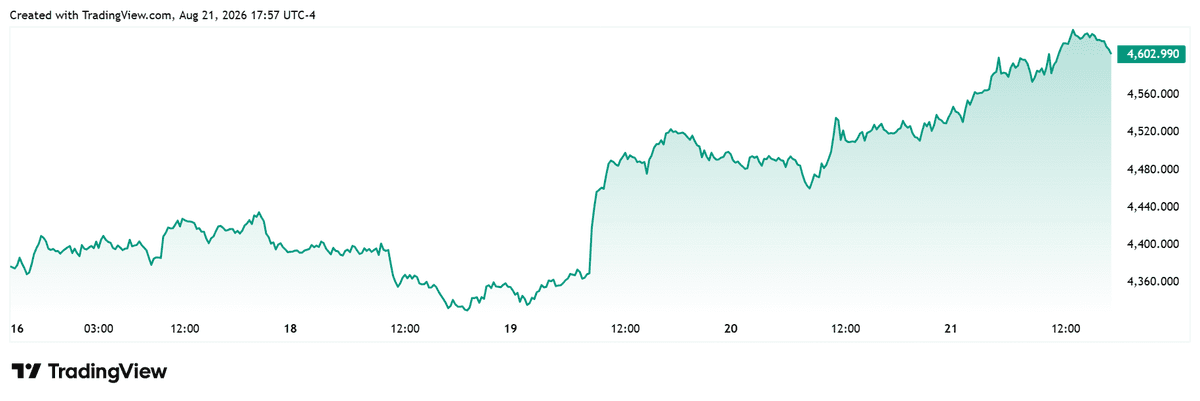
(Kitco News) – Gold prices surged to their third straight weekly gain, as concerns over U.S. debt sustainability, a weaker dollar, and the Treasury Department’s surprise move to expand long-dated bond buybacks helped the precious metal break above $4,600 per ounce.
Spot gold kicked off the week trading at $4,381.12 per ounce on Sunday evening, and pushed higher Monday as traders continued to buy the previous week’s rebound. The move stalled Tuesday as long-dated Treasury yields climbed and the U.S. dollar held firm, with spot prices ultimately setting their weekly low at $4,324.49 per ounce early Wednesday morning.
Gold’s breakout came just a few hours later when the U.S. Treasury announced that it would double the size of buybacks for 10- to 30-year debt securities to at least $4 billion per operation, a move that briefly drove long-end yields lower and intensified concerns about the sustainability of U.S. borrowing as total public debt neared $40 trillion. The dollar weakened after the announcement, and gold surged above $4,500 as investors moved into hard assets.
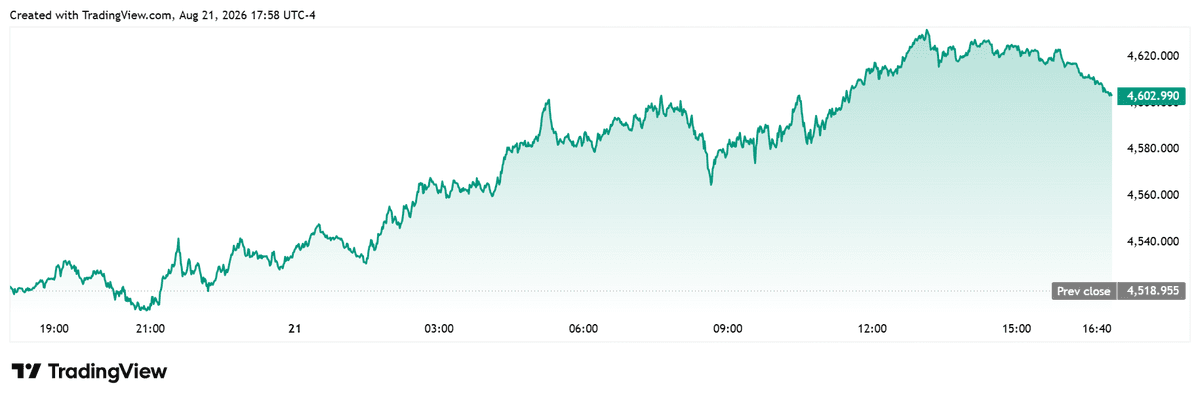
The rally extended Wednesday afternoon when the July FOMC minutes showed policymakers still focused on inflation but unlikely to deliver further rate hikes in the near term. Gold held above $4,500 on Thursday, then accelerated again through Friday’s trading session as fiscal worries, dollar weakness, and renewed precious-metals demand outweighed stronger U.S. services PMI data and rising yields.
Spot gold ultimately set its weekly high at $4,632.14 per ounce on Friday afternoon and held above $4,600 per ounce at the weekly close.
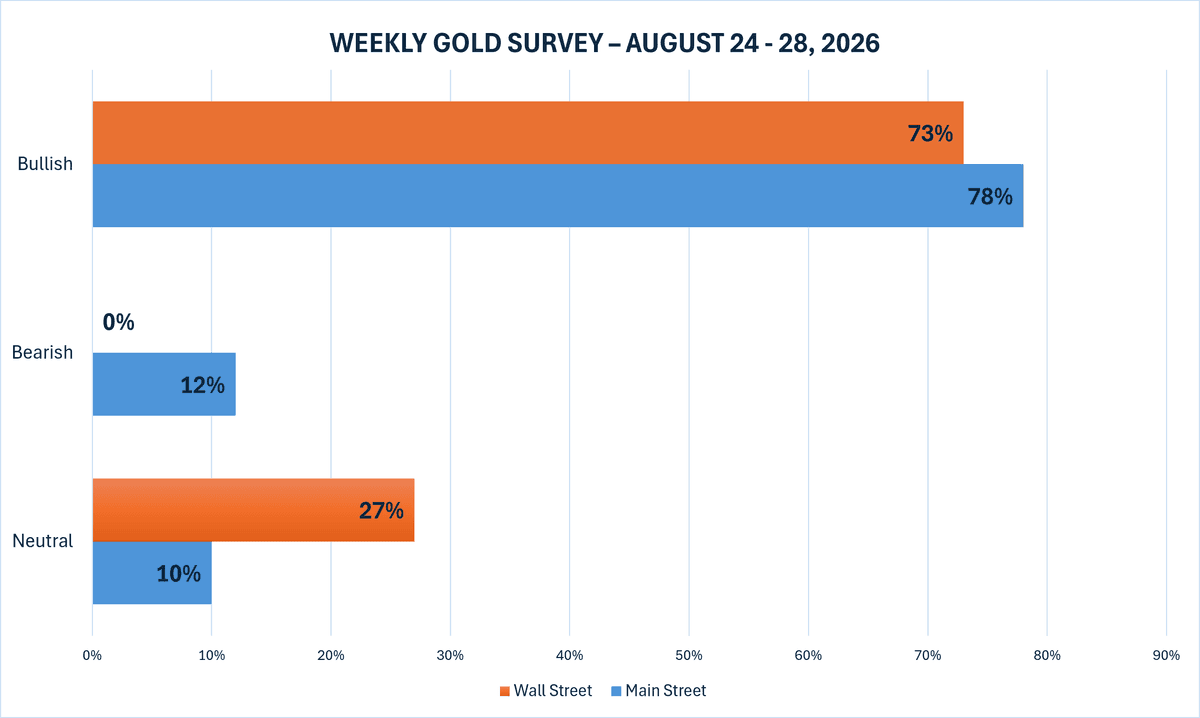
The latest Kitco News Weekly Gold Survey showed Wall Street bereft of bears after gold’s late-week surge, while Main Street sentiment shot higher into bullish territory.
“Gold rose for the third consecutive week,” said Marc Chandler, managing director at Bannockburn Global Forex. “It poked above $4600 at the end of the week. Gold overcome the 200-day moving average for the first time in two months and surpassed the 38.2% retracement of its losses from the record high in March. A convincing move above $4600 targets the $4680 area.”
“The fundamental driver appeared to be what is perceived by many as another attempt by the US Treasury to suppress the rise in long-term yields without reducing issuance,” Chandler noted. “Still, momentum indicators are stretched, and participants should be on watch for some kind of technical signal of a reversal or consolidation.”
“Up,” said Darin Newsom, senior market analyst at Barchart.com. “Why? Well, I tried to buck the trend last week and that didn’t turn out so well. The bottom line is, as my Rule #6 reminds us, fundamentals win in the end, and as long as central banks around the world continue to buy, gold is fundamentally bullish.”
“The other bottom line is this past week showed why the rest of the world continues to sell the United States,” Newsom said. “Given this isn’t going to change any time soon, gold (and silver) should stay fundamentally bullish for the foreseeable future.”
“Higher,” said Adam Button, head of currency strategy at investingLive. “The U.S. ‘strong dollar’ policy is dead and Bessent is flailing.”
“Up,” said Adrian Day, president of Adrian Day Asset Management. “The short-term effect of US Treasury Secretary Bessent’s decision to increase buybacks of long bonds will fade, but the fundamental problems this Operation Twist exposes will not.”
“Bessent has decided to attempt to save the bond market at the expense of the dollar,” Day said, “and this is positive for gold.”
“Up,” said Rich Checkan, president and COO of Asset Strategies International. “Forget about a war or peace premium. Forget about interest rates for now. Treasury Secretary Scott Bessent vowed to at least double the buybacks of long-dated U.S. Treasuries. In other words, he plans to at least double the current pace of buying debt with new debt.”
“This is incredibly inflationary as he is planning to expand the money supply faster than he currently is,” Checkan said. “More U.S. dollars chasing a finite amount of gold means only one thing… higher prices.”
Kevin Grady, president of Phoenix Futures and Options, told Kitco News the Treasury Department’s intervention in the bond market pushed all other drivers to the side this week.
“It’s all about the bonds right now,” he said. “That’s the whole story. Obviously, people are interested in crude oil, this and that, but this week, these moves in gold, it’s all about the bonds.
Grady said the signal Bessent sent with the intervention is more significant than the purchases themselves.
“They’re going to double purchases, but when people say, ‘Oh, we’re going to raise again, we’re going to raise again, we’re going to raise again,’ that just shows me there’s a systemic problem,” he said. “When you have to come in and intervene like that, I think it’s a problem, and I think the market is going to have to eventually deal with this.”
But while the increased bond buybacks are unlikely to have a sustained impact on yields, the tide appears to be turning for precious metals.
“I wasn’t bullish during the summer,” he said “I didn’t see any increase in open interest and things like that. But we’re starting to see some increase in open interest, they’re adding on, new longs coming into the market.”
Grady said there are reasons why the back end of the board is so high in the first place. “Obviously, we just hit $40 trillion in deficit, which is a massive thing, and people aren’t talking about it.”
The other major factor driving yields higher is the AI capex. “When you have Google paying a 30-year bond or a 60-year bond or whatever, they’re paying far out on the curve, and they’re paying you 6.4% on a 30-year bond,” he said. “Google doesn’t have the creditworthiness of the United States government, but some people are like, ‘You know what? I think it’s pretty close.’”
“At this point, you’re going to have a really hard time pulling [yields] back.”
But despite gold’s standout performance this week, Grady said he’s still waiting for confirmation from energy prices, inflation data, and the Fed before he believes in gold above $4,600.
“We need to see some more data, and we’ll see what the Fed does,” he said. “I think September’s going to be interesting, and we’ll see what happens with rates. And if gas is $4.10 a gallon, I think that’s going to sneak into the inflation. It has to [impact] the inflation story, there’s no other way to do it.”
“I think we have to just wait to see what happens with this bond story, and with the interest rates, and we’ll see if the market can sustain it.”
This week, 11 analysts participated in the Kitco News Gold Survey, with Wall Street sentiment leaning overwhelmingly bullish after gold’s decisive move through key resistance levels. Eight experts, or 73%, expected to see gold prices gain ground during the week ahead, while the remaining three analysts, 27% of the total, saw the yellow metal consolidating its gains next week. None predicted a price decline.
Meanwhile, 211 votes were cast in Kitco’s online poll, with Main Street investors adding to their bullish majority after gold’s standout performance. 164 retail traders, or 78%, looked for gold prices to rise next week, while 25 others, or 12%, predicted the yellow metal would lose ground. The remaining 22 investors, representing 10% of the total, expected to see sideways trading during the week ahead.
Next week’s economic news calendar features fresh readings on consumer confidence, housing, inflation and economic growth, with new Fed Chair Warsh’s first Jackson Hole speech on Friday the clear highlight.
The week’s data kicks off Tuesday morning with the Conference Board’s Consumer Confidence Index, along with New Home Sales for July.
Wednesday then brings the week’s heaviest concentration of economic data, with the Core PCE Price Index, the second estimate of Q2 GDP, and Durable Goods Orders all scheduled for release at 8:30 am ET. Then on Thursday morning, traders will watch for the weekly jobless claims report.
The week’s main event will be Fed Chair Kevin Warsh’s Friday morning speech at Jackson Hole, with markets looking for clues as to the timing of the Fed’s next move. Friday morning with also see the release of preliminary annual benchmark revisions to nonfarm payrolls, along with the University of Michigan’s final Consumer Sentiment reading for August.
Lukman Otunuga, manager of market analysis at FXTM, said gold is flexing its muscles heading into the weekend after the Treasury’s surprise move to ramp up buybacks of long-dated government debt.
“The precious metal has jumped over 5% since Monday and is on track for its third consecutive weekly gain,” he wrote. “With yields and the dollar sliding on the Treasury move which landed Wednesday, the path of least resistance points north.”
While yields have retraced much of their initial decline, Otunuga said the underlying signal remains, as concerns about the scale of U.S. debt and currency debasement support gold.
“A weaker dollar remains gold’s clearest tailwind, and this week’s explosive price action reflects that directly,” he said.
Looking ahead, Otunuga believes July PCE data and Fed Chair Warsh’s Jackson Hole speech could prove pivotal. “The PCE report will shape near-term rate expectations, while Warsh’s address, alongside the BLS’s annual payroll benchmark, may set the tone for gold in September,” he said.
Turning to the technicals, Otunuga pointed out that gold remains firmly bullish above the 200-day SMA. “A solid breakout and daily close above $4,600 could see prices test $4,700,” he said. “Weakness below $4,500 may expose $4,390 – a level near the 100-day SMA.”
Naeem Aslam, chief investment officer at Zaye Capital Markets, said the gold market is being supported by several overlapping forces rather than one single catalyst.
“Geopolitical tension is increasing demand for portfolio protection, softer inflation components are keeping future rate cuts in discussion, weak housing activity shows that restrictive financial conditions are still working, and stable business inflation expectations reduce the risk of a fresh broad inflation shock outside energy,” he wrote. “For gold, the most important variables now are real yields, the U.S. dollar, oil prices, and whether today’s European data strengthen or weaken expectations for monetary easing.”
“If geopolitical stress remains elevated while bond yields soften and the dollar fails to strengthen materially, gold’s position above US $4,500 can remain supported,” Aslam said. “If stronger economic data push real yields meaningfully higher, however, the metal could face consolidation even with safe-haven demand still present.”
Carsten Fritsch, commodity analyst at Commerzbank, wrote that the Treasury’s sudden buyback announcement followed a sharp rise in bond yields in the preceding days.
“The main beneficiary of this is gold, as evidenced by strong inflows into gold ETFs,” he said. “Holdings in the gold ETFs tracked by Bloomberg recorded their strongest daily increase since September 2025 yesterday, at 18 tons. On the gold market, the US Treasury’s announcement was seen as a sign of stress. The sharp rise in US bond yields in the preceding days was not, in fact, due to a change in Fed interest rate expectations, but rather to long-term inflation risks and growing concerns about debt levels.”
Fritsch noted that interest payments are expected to cost the U.S. government $1.1 trillion this fiscal year – representing a threefold increase from five years ago. “Given this trend, it is clear why US President Trump is calling on the Fed to cut interest rates and why an interest rate hike would probably be met with fierce criticism from the White House,” he said. “It is therefore hardly surprising that the minutes of the Fed’s latest meeting were largely ignored by the market, even though they struck a rather hawkish tone.”
Alex Kuptsikevich, senior market analyst at FxPro, expects gold prices to rise once again next week, but he also warned of a potential pullback.
“It seems that gold provided an example of a situation where technical analysis was the first to signal a move, with fundamental factors following later,” he said. “The reversal of the downtrend in early August prompted a reassessment of the outlook. The weakening of the dollar and the US Treasury’s announcement last week supported the rise in prices. Having gained nearly 5% over the week, gold has settled above the 200-day moving average and above the psychologically significant level of $4,500.”
Kuptsikevich pointed to Bessent’s promise to increase bond purchases as the fundamental driver for gold’s appreciation. “As these are market interventions rather than solutions to the root cause of the crisis, money has flowed out of bonds and into inflation hedges: gold and cryptocurrencies,” he said. “The strength of this movement is an important signal that we are witnessing the start of a new cycle in the markets, rather than mere market noise. That said, in the coming weeks, it is still reasonable to expect less pronounced performance from gold, with potential for growth to $4,800 and even a corrective pullback lasting a couple of days.”
Michael Moor, founder of Moor Analytics, expects to see gold prices rise further next week.
“In a Higher time frame: I cautioned on 8/16/18 the break above $1,183.0 warned of renewed strength,” he said. “We have seen $4,443.1. These are OFF HOLD. We held exhaustion with a 56268 high and rolled over $1,651.1. This is ON HOLD. On a medium timeframe basis: The trade below 52554 projected this down $740 (+)—we attained $1,300.0. The trade below 52036 brought in $1,248.2 of pressure. The trade below 51606 brought in $1,205.2 of pressure. These are ON HOLD. We held exhaustion with a 49177 high after a pullback and rolled over $962.3. The break below 48185 projected this down $185 (+)—we attained $863.1. The trade below 47923 projected this down $205 (+)–we attained $836.9. The break below 47420 brought in $786.6 of pressure. These are ON HOLD. We held macro exhaustion with a 39554 low and bounced $687.5—if we continue in a bona fide bullish correction, the minimum target is 49636. This is OFF HOLD.”
“On a lower timeframe basis: We held exhaustion with a 40190 low and bounced $623.9,” Moor wrote. “The trade above 41192 brought in $523.7. On 8/4 we left a bullish reversal—we have rallied $520.5 from the 41224 open. The break above 41389 projects this upward 345.00 (+)—we attained $504. On 8/5 we left a major bullish reversal—we have rallied $337.7 from the 43052 close. The break above 44170 (-3.6 tics per/hour) has brought in $225.9 of strength. The break above 44311 (+13 tics per/hour) has brought in $211.8 of strength. The trade above 44853 (-2 tics per/hour) has brought in $157.6 of strength. The fact we took out the 46240-71 area is a sign of continued strength.”
At the time of writing, spot gold last traded at $4,602.99 per ounce for a gain of 5.27% on the week and 1.86% on the day.
See live precious metals prices for gold, silver, platinum and palladium — in USD, CAD and 12 more currencies.
Kitco.com

