 Goontrading

🚀 Experience Ultra-Low Latency Trading — 🛡️ Trade with a Regulated Global Broker
Wheat futures are correcting part of their recent surge on the Chicago Board of Trade, although prices remain clearly above the levels seen at the start of the year. After almost four years of persistent declines, wheat prices have begun to recover, as investors increasingly recognise that the market’s fundamental backdrop is deteriorating. This time, the problem is not driven by a single event, but by the combination of drought, export disruptions in the Black Sea region and growing uncertainty surrounding global fertiliser supplies.
Since the beginning of 2026, wheat futures have gained nearly 25%. Importantly, this move has taken place without the kind of sudden supply shock seen after Russia’s invasion of Ukraine in 2022. The current market structure is considerably more complex.
On the one hand, investors are pricing in weaker crop prospects for the current season. On the other, logistical risks surrounding exports from the Black Sea region are rising. It is this combination that is bringing a risk premium back into wheat futures pricing.
The Black Sea is becoming a problem again
Russian missile strikes on ports in Odesa, together with Ukrainian attacks on vessels and infrastructure in the Sea of Azov, have significantly disrupted exports from the region. At the same time, increased risks to Russian Black Sea ports have pushed up freight and insurance costs. The impact is already visible in the data, with total grain shipments from the Black Sea in late July more than 40% lower than a year earlier.
This is particularly important because Russia and Ukraine together account for roughly 32% of global wheat trade. Some Ukrainian exports can be redirected by rail or through the Danube to Romanian ports, but these routes are more expensive and have limited capacity. Russia also lacks an easy alternative, as Baltic and Arctic ports are located far from the main producing regions and are not equipped to handle comparable volumes.
Drought is beginning to weigh on global production
The second major driver behind the recent rally is the worsening weather outlook. Widespread drought has affected large parts of the Northern Hemisphere, while the latest USDA projections point to a meaningful decline in production among most of the world’s leading wheat exporters.
The key forecasts include:
- Production among the world’s seven largest wheat exporters is expected to decline by around 11% in the 2026/27 marketing year.
- Global wheat exports are projected to fall by approximately 7%.
- US wheat production is expected to decline by around 26%, while exports could drop by nearly 15%.
- Canadian wheat output is forecast to fall by approximately 15%.
- Australia is expected to reduce wheat plantings by around 12% due to drought conditions and elevated fertiliser costs.
- Argentina is also expected to produce a smaller crop, although the developing El Niño weather pattern could partially offset some of the downside risks.
Although crop prospects in Russia and Ukraine remain relatively favourable compared with other producing regions, the bigger challenge is no longer production itself but the ability to move grain efficiently to global markets. As a result, logistical constraints are becoming almost as important as crop yields in determining the global wheat balance.
The market is beginning to price in higher volatility
As market fundamentals have weakened, implied volatility in wheat futures has also increased noticeably. Before the outbreak of the latest US-Iran conflict, volatility had remained below its 10-year average. The closure of the Strait of Hormuz triggered a sharp spike in volatility, which later eased as hopes for a lasting ceasefire improved sentiment. Since early July, however, volatility has started to climb again.
This shift suggests that investors are increasingly pricing in the risk of further supply disruptions, even though physical shortages have yet to materialise. The market is no longer reacting solely to current supply conditions but also to the growing probability that logistical bottlenecks could tighten global availability in the months ahead.
The risks extend well beyond wheat itself. Export disruptions also affect Ukrainian corn and sunflower oil, while Russia remains a major supplier of fertilisers, including urea, phosphates and potash. At the same time, continued tensions surrounding the Strait of Hormuz have increased concerns over global fertiliser shipments, potentially raising agricultural production costs far beyond Europe.
Why this rally is different from 2022
The current rally bears little resemblance to the supply shock that followed Russia’s invasion of Ukraine in 2022. At that time, the market reacted to the sudden disruption of exports from one of the world’s most important grain-producing regions, only for prices to retreat rapidly as alternative trade routes were established and the Black Sea Grain Initiative restored part of the lost export capacity.
Today’s environment is different. Although price gains have been more measured, the underlying drivers appear considerably more persistent. Smaller harvests, tighter fertiliser availability, rising transportation costs and ongoing geopolitical tensions are reinforcing one another rather than acting as isolated events. Individually, none of these factors would likely be enough to sustain a major bull market. Together, however, they are gradually tightening the global wheat balance and rebuilding a structural risk premium.
If export disruptions in the Black Sea persist and global crop forecasts continue to deteriorate, wheat could remain one of the most fundamentally supported agricultural commodities during the second half of the 2026/27 marketing season.
WHEAT chart (D1)
Agricultural commodities remain among the most weather-sensitive and volatile asset classes. Wheat has already corrected roughly 10% from its recent highs, but the broader fundamental picture remains intact. Should sentiment stabilise after the recent pullback, the combination of tightening supply expectations and improving fundamentals could encourage buyers to re-enter the market.

Source: xStation5
Commercial hedgers are increasing their hedges while funds return to the long side
The latest Commitment of Traders (COT) report highlights a widening divergence between the two most influential groups in the wheat market. During the week ending July 28, Managed Money increased its long positions by 10,962 contracts, while short positions rose by just 726 contracts. The data indicate that speculative funds are becoming increasingly constructive on wheat, adding exposure in anticipation of further upside.
At the same time, commercial participants increased their short positions by 2,646 contracts while reducing long positions by more than 5,000 contracts. This is a classic pattern in agricultural futures markets: higher prices encourage producers and grain merchants to lock in future sales, while speculative capital begins pricing in a tightening supply outlook. Importantly, this type of positioning should not automatically be interpreted as a bearish signal. Historically, commercial hedging often increases during the early stages of sustained bull markets as producers use higher prices to secure forward revenues.
Funds are still rebuilding positions, leaving room for further upside
Despite the recent wave of buying, speculative positioning remains far from stretched. Managed Money currently holds roughly 85,000 long contracts against approximately 93,000 short contracts, leaving the group with a modest net short position. In other words, recent buying appears to represent the early stages of position rebuilding rather than the final phase of speculative enthusiasm.
From a market perspective, this is an important distinction. If global crop prospects continue to deteriorate and export disruptions in the Black Sea region persist, speculative funds still have considerable room to cover remaining short positions and eventually move into a net long stance. Historically, this gradual transition from net short to net long positioning has often provided one of the strongest sources of momentum during multi-week rallies in CBOT wheat futures.
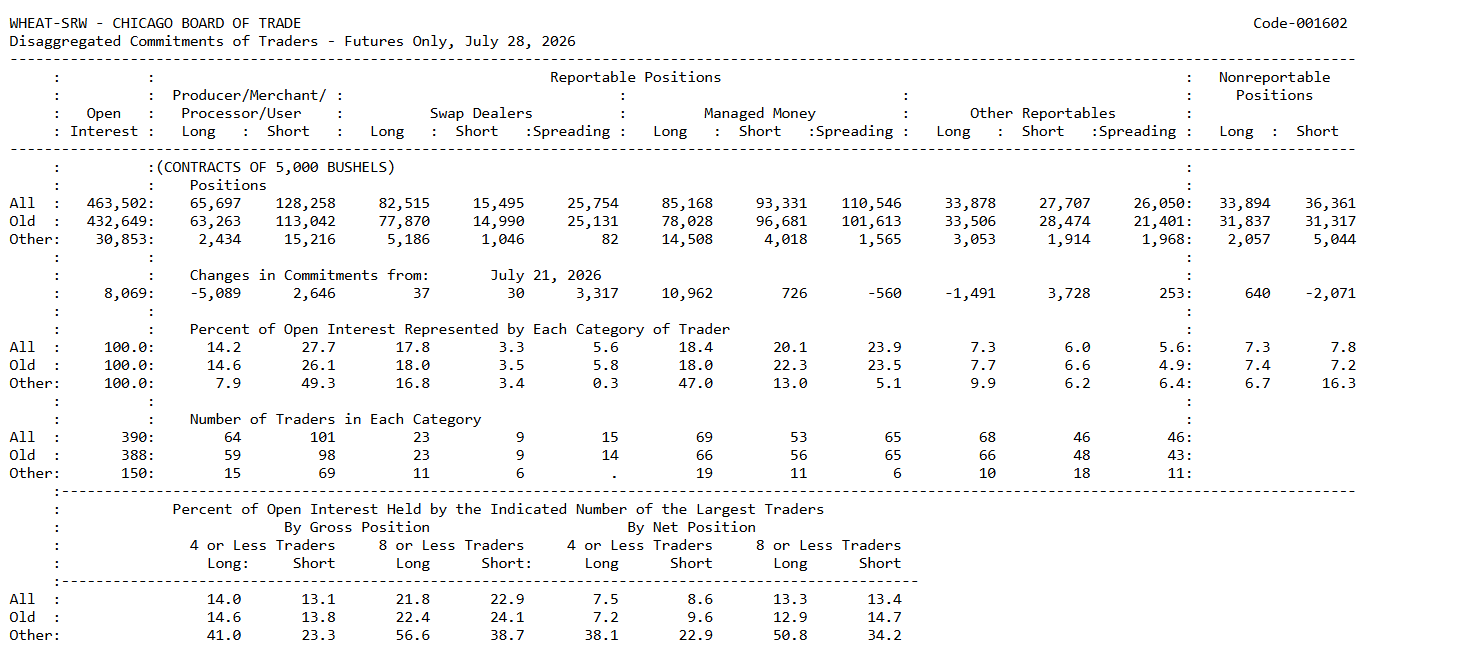
Source: CFTC, CoT (28 July)
XTB.COM

